
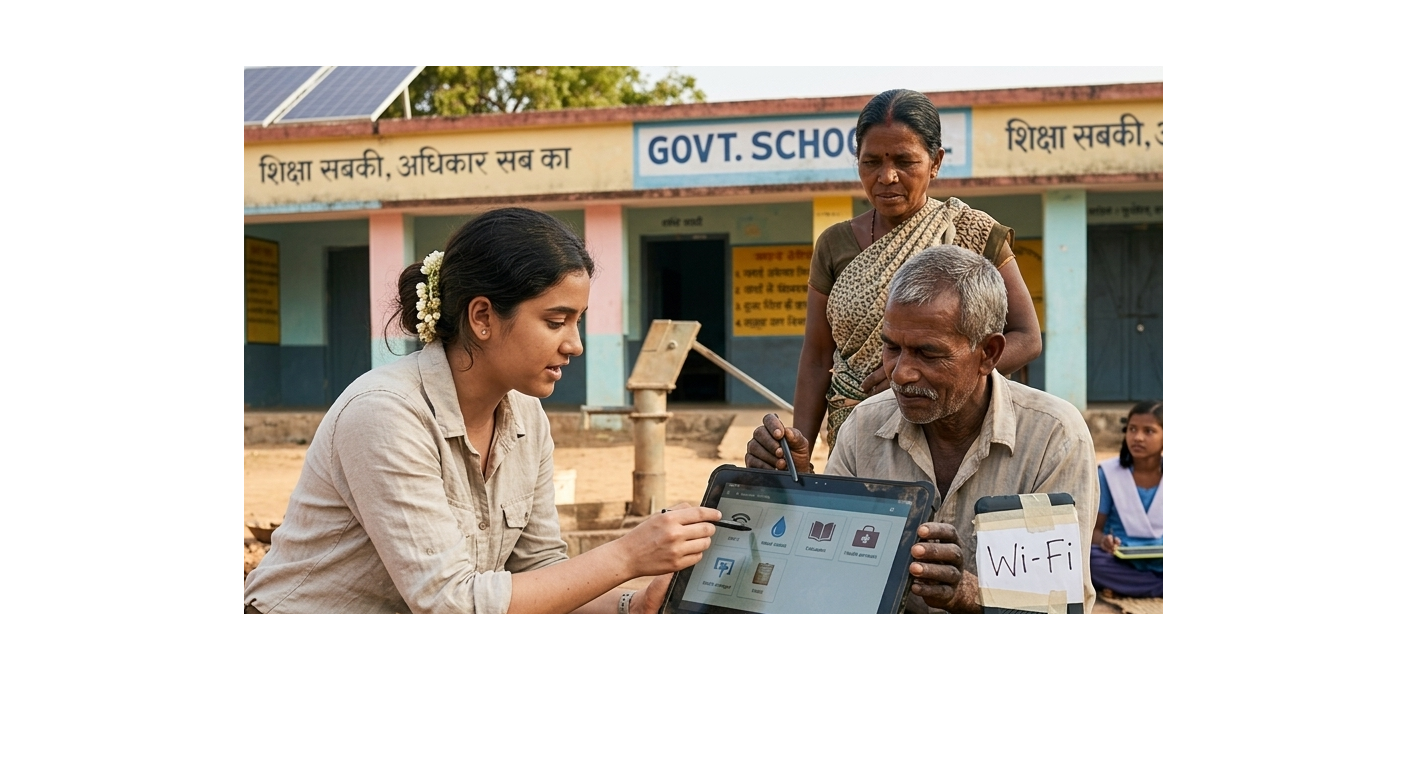
Lessons from digitizing rural education for first-time tech users in rural India
The Problem With Building Social Impact Products Like SaaS Startups
Last year, while building the Neev app for Hamari Laado’s rural coaching program with Otobot, we started with SaaS-style roadmaps ; feature parity, growth metrics, viral loops and so on. While we discussed usability and adoption, most of it still had a regular smartphone user as the key persona. Questions that added value were the most basic ones including; Do they have stable mobile data? What is the basic phone model to design for?
Regular product thinking no longer applies in this context, where the rules are completely different. Social impact products aren’t just SaaS for good. They operate in fundamentally different constraints, resource scarcity, intermittent connectivity. First-time tech users, user resistance, are an added layer that needs a product strategy that acknowledges this reality.

How Product Strategy Differs for Social Impact vs. Venture-Backed SaaS?
Let me be clear about what I mean by social impact products. Digital solutions built for schools, NGOs, government programs, and community organizations. Think of education apps used by teachers and coaches, health information platforms for rural clinics. Basic aim of the apps being attendance-tracking, patient history, appointment schedules, systems in under-staffed schools, or the likes.
In Social Impact, User Context is Everything
In SaaS, your end-user has all the background conducive to start using the app on day 1. In social impact, your user is:
- A teacher in a school with one shared tablet/ low end mobile phone and intermittent 2G connectivity
- A rural health worker who’s never used a smartphone independently except for WhatsApp/Instagram
- A young woman (often a girl, actually) in a rural area seeing digital tools for the first time
- Users who sees technology as a compliance burden, not an opportunity
- Folks who would love to go back to pen and paper at the slightest hit of difficulty.
This changes everything about how you design the product and measure success.
Social Impact User adoption isn’t about converting power users but about creating habit in unfamiliar ground
The Neev app scaled from 600 to 5000 students across 5 states in its maiden release. The turning point here wasn’t a feature heavy app. It was understanding that a coach using the app for 2 minutes every session, consistently, across the 20 sessions, was exponentially more valuable than a coach who used it for 5 minutes for the first 5 sessions.
Habit formation in resource-constrained environments looks different. You can’t assume regular touch-points (erratic schedules, coach absences, network issues). You need to make the app so useful for a specific 2-minute workflow that it becomes part of the routine, like taking attendance or distributing materials.
Less is more, what and how much to track?
A social impact product doesn’t get the luxury of full-time employees dedicating their time and effort towards the goal.
This means every product decision has to be scrutinized. Will this be an overhead for the volunteers we’re creating the app for? Not just: “Is this a cool feature?” For conducting a one hour lesson, will the coach have to spend 30 minutes on the app? No, this does not serve the purpose.
Here’s what doesn’t work: one-off research visits, online surveys, or asking stakeholders what they want. Here are a few different things to try:
Embedded Discovery: Live with the Problem
While building for Hamari Laado, we hit the ground running. The experienced volunteer team on the ground doubled as our product eyes in schools for weeks, observing the users to find out:
- When do coaches actually have the bandwidth to engage with the app?
- What interruptions happened? (lack of time, network issues, bugs, usability issues)
- What mobile phones and internet connections did the coaches have?
- What prior tech experience did the coaches have (and what misconceptions did they carry)?
This revealed something counter intuitive: low engagement wasn’t fear of new tech; it was unrealistic usage expectations. Coaches in low network areas ended up taking way too longer to complete the most basic tasks.
Map the full adoption ecosystem, not just the direct user
For a social impact app, your product decisions affect:
- Coaches (direct user)
- NGO – Ops (direct user – material distribution)
- NGO – Admin (direct user – onboarding, reporting, payments)
- NGO – Admin (decision-maker)
- Government officials (stakeholder – dashboards, compliance reports)
- Donors (stakeholder – dashboards, impact reports)
Hamari Laado’s scaling happened when we understood that the master coaches support was as important as coach’s willingness. One product decision: a master coach dashboard showing coaches session progress and engagement. This was essential for adoption because it gave master coaches visibility and accountability.
Measuring social impact alongside adoption: The dual metric trap
This is where social impact products get tricky. You care about both:
- Product adoption metrics (daily active users, time spent, feature usage
- Impact metrics (learning outcomes, behaviour change, reach in intended communities)
The trap: assuming they’re correlated. They’re not always.
Example: An app with high usage (coaches open it for every lesson) but zero impact on student learning. If the app is just a tracking tool for attendance, you get all the data required for metrics. But this does not enable the coach in improving the teaching experience. Or an app with drive genuine social gains but have low adoption because it requires high time commitment.
Here’s how we structured this:
Tier 1: Adoption (Product Health)
- Number of sessions entered in the app by coaches
- Number of students with completed profiles
- Number of coaches with completed profiles
- Number of students with completed pre and post surveys
Tier 2: Contextual Use (Quality Adoption)
- Coaches using the app to complete missing profiles
- Coaches using the app to learn and prepare better for the lesson
Tier 3: Impact (Why We Built This)
- Program outcomes (pre and post surveys)
- Impact metrics (scale of operations, expense tracking)
- Sustainability metrics (reduced ops effort, efficient execution)
For Hamari Laado, impact wasn’t just whether coaches entered lesson info in the app. It was:
- Are they conducting lessons as intended?
- Are they well equipped to conduct the lessons?
- Are behavioural or decision-making changes happening amongst attendees?
This last point is critical: social impact products must prove they actually reach the right audience, and enable them.
Scaling Hamari Laado to 200 + Coaches, ~4000 students in a single cohort
Zero Prerequisite Knowledge
Coaches in partner schools had minimal prior tech exposure. The app couldn’t assume anything. Every action had to be self-evident. If a user was confused, the design had failed, not the user.
Short 5-Minute Workflows
Instead of asking teachers to spend 10 minutes updating 1 hour lessons, Hamari Laado app has razor sharp focus. Can we save a teacher 5 minutes every lesson? Can we give them a faster way to record attendance? A quick way to add run information? An easy to read report for the admins?
These small time savings accumulated. Coaches used it consistently because it made their life easier right now, not someday.
Products designed for constraint are often more elegant than products designed for abundance. When you can’t assume bandwidth, you learn to value every byte. When you can’t assume prior knowledge, you design for absolute clarity. When you can’t assume funding forever, you design for sustainability. The social impact products that last, that scale, that reach thousands(and in the near future 10s of thousands) of rural students aren’t the ones with the flashiest features. They’re the ones that understood the environment deeply and designed relentlessly within its constraints.
If you’re navigating this challenge, we work with mission-driven founders and organisations to build product strategies that reach and serve underserved communities.
Explore product consulting for mission-driven organizations →
Or if you want to start with customer discovery in your specific context; schools, rural areas, NGO communities, a Discovery Sprint can clarify your users’ actual needs before you invest in building.
If you have navigated this space, would love to hear your learning experiences.
Leave a Reply